


The Supplemental Nutrition Assistance Program — still commonly called food stamps — is one of the largest and most effective anti-poverty programs in the United States. It helps millions of households afford the groceries they need to stay healthy. Yet despite its reach, a surprising number of people who qualify never apply. Among older adults, the gap is especially wide: roughly three out of five eligible seniors are not enrolled.
If you've ever wondered whether you qualify, or assumed you make too much money to be considered, this guide walks you through what SNAP actually looks at, how to apply, and the deductions that could make you eligible even if your paycheck seems too high on the surface.
What SNAP Covers — and What It Doesn't
SNAP benefits are loaded monthly onto an Electronic Benefit Transfer (EBT) card, which works like a debit card at authorized grocery stores, supermarkets, farmers' markets, and certain online retailers. You can use SNAP to purchase fruits, vegetables, meat, dairy, bread, cereals, snack foods, seeds, and plants that produce food.
You cannot use SNAP to buy alcohol, tobacco, vitamins, medicines, hot prepared foods, or non-food items like cleaning supplies and pet food. Some states have recently added further restrictions — for example, Texas began limiting SNAP purchases of certain sweetened beverages and candy starting in April 2026.
Who Qualifies for SNAP
SNAP eligibility is determined by three main factors: your household size, your gross income, and your net income after deductions. For the current federal fiscal year (October 2025 through September 2026), a household of three must have a gross monthly income at or below $2,888 and a net monthly income at or below $2,221 to qualify under federal guidelines.
Those numbers shift with household size — a single person faces a lower threshold, while larger families have higher limits. And importantly, over 40 states use Broad-Based Categorical Eligibility (BBCE), which raises or eliminates certain income and asset tests. This means many more people qualify than the federal baseline would suggest.
If your household includes someone who is 60 or older or has a disability, the rules become more generous. These households only need to meet the net income test — the gross income test is waived entirely. Asset limits are also higher: $4,500 for households with an elderly or disabled member versus $3,000 for all others.
The Deductions That Change Everything
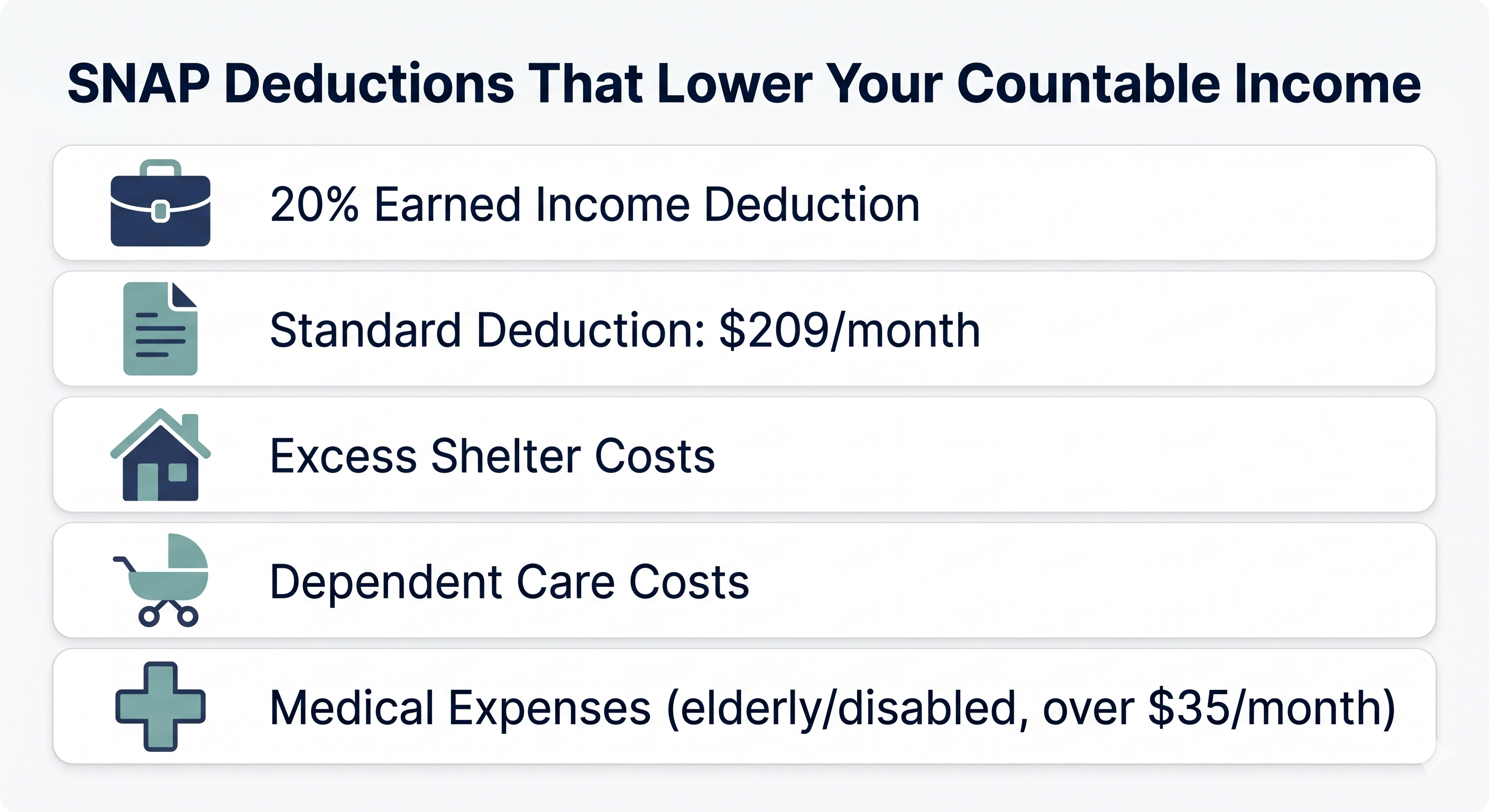
Many people look at their gross income and assume they won't qualify, but SNAP's deduction system is specifically designed to account for real-world expenses. The program allows a 20 percent deduction on all earned income right off the top. On top of that, every household receives a standard deduction — $209 per month for households of one to three people during the current fiscal year.
Additional deductions are available for dependent care costs (such as daycare), legally owed child support payments, high shelter costs, and — for elderly or disabled households — medical expenses that exceed $35 per month. These deductions can dramatically lower your net income on paper, making you eligible even when your gross paycheck says otherwise.
How to Apply, Step by Step
SNAP is administered at the state level, which means you apply through your state's human services agency — not through a federal office. Here is the general process:
Find your state's application portal. Most states offer an online application. You can locate yours through the USDA's SNAP state directory or by searching for your state's name plus "SNAP application" online. Many states also accept applications in person at local SNAP offices or by mail.
Submit your application. The application asks for basic information about your household: who lives with you, your income sources, your monthly expenses (rent, utilities, childcare), and any assets. You do not need to have every document ready at this stage — getting the application submitted starts the clock on your eligibility date.
Complete your eligibility interview. After submission, your state agency will schedule an interview, usually by phone. This is a conversation to verify the information on your application and discuss any deductions you may be entitled to. Have your pay stubs, rent or mortgage statements, utility bills, and any relevant medical expense records available.
Receive your determination. In most cases, your state agency will process your application and notify you of the decision within 30 days. If approved, your benefits are backdated to the day you submitted your application — so don't delay submitting, even if you're still gathering documents.
If you're in crisis, you may qualify for expedited benefits. If your household has less than $100 in liquid assets and $150 in monthly gross income, or if your combined income and assets are less than your monthly rent and utilities, you may receive benefits within seven days.
How Much Can You Receive
The maximum monthly SNAP benefit for a household of three is $785 for the current fiscal year. The actual amount you receive depends on your net income after deductions — the formula subtracts 30 percent of your net income from the maximum benefit for your household size. A family of three with $600 in net monthly income, for example, would receive approximately $605 per month.
The average benefit per person nationally is estimated at around $188 per month, or roughly $6.17 per day. While that may not sound like a lot, it represents real purchasing power at the grocery store — especially when combined with strategic shopping.
Work Requirements to Be Aware Of
SNAP has long had work requirements for able-bodied adults without dependents (known as ABAWDs). As of February 2026, updated rules expanded these requirements to include adults aged 55 to 64 without dependents, who may need to work, volunteer, or participate in a job training program for at least 80 hours per month to maintain benefits. People with disabilities, caregivers of young children, and those over 64 are generally exempt.
If you fall into a category that requires work participation, check with your local SNAP office about qualifying activities — many states count volunteer work, job training programs, and educational programs toward the requirement.
Tips for Maximizing Your SNAP Benefits
Report all your deductible expenses. Many applicants underreport shelter costs or skip medical expense documentation, which reduces their calculated benefit. If you're paying out-of-pocket for prescriptions, co-pays, medical transportation, or assistive devices, document and report these costs.
Recertify on time. Your SNAP benefits are approved for a set period (your "certification period"). You'll receive a notice before it expires with instructions to recertify. Missing this deadline means a gap in your benefits, and you'll have to reapply from scratch.
Use your EBT card at farmers' markets. Many farmers' markets accept SNAP, and some offer matching programs where your SNAP dollars are doubled on fresh produce purchases.
If your situation changes — a job loss, a new household member, a rent increase — report it to your local office. Changes that increase your expenses or reduce your income could increase your benefit amount.
Sources
U.S. Department of Agriculture, Food and Nutrition Service. "SNAP Eligibility." fns.usda.gov/snap/recipient/eligibility
Center on Budget and Policy Priorities. "A Quick Guide to SNAP Eligibility and Benefits." October 2025. cbpp.org
National Council on Aging. "What Is the Highest Income to Qualify for SNAP?" February 2026. ncoa.org
/sites-cdn/openfinancial.co/images/2026/05/04/Gemini_Generated_Image_fhea9gfhea9gfhea.png?width=256&height=256&fit=cover)
/sites-cdn/openfinancial.co/images/2026/05/04/Gemini_Generated_Image_21fcul21fcul21fc.png?width=256&height=256&fit=cover)
/sites-cdn/openfinancial.co/images/2026/05/04/Gemini_Generated_Image_q1hbg5q1hbg5q1hb.png?width=256&height=256&fit=cover)
/sites-cdn/openfinancial.co/images/2026/05/04/Gemini_Generated_Image_z00edhz00edhz00e.png?width=256&height=256&fit=cover)
/sites-cdn/openfinancial.co/images/2026/05/04/Gemini_Generated_Image_fhea9gfhea9gfhea.png?width=448&height=448&fit=cover)
/sites-cdn/openfinancial.co/images/2026/05/04/Gemini_Generated_Image_21fcul21fcul21fc.png?width=448&height=448&fit=cover)
/sites-cdn/openfinancial.co/images/2026/05/04/Gemini_Generated_Image_q1hbg5q1hbg5q1hb.png?width=448&height=448&fit=cover)
/sites-cdn/openfinancial.co/images/2026/05/04/Gemini_Generated_Image_z00edhz00edhz00e.png?width=448&height=448&fit=cover)
/sites-cdn/openfinancial.co/images/2026/04/30/apply_for_snap_benefits.png?width=448&height=448&fit=cover)
/sites-cdn/openfinancial.co/images/2026/05/02/Gemini_Generated_Image_w9gc9w9gc9w9gc9w.png?width=448&height=448&fit=cover)