
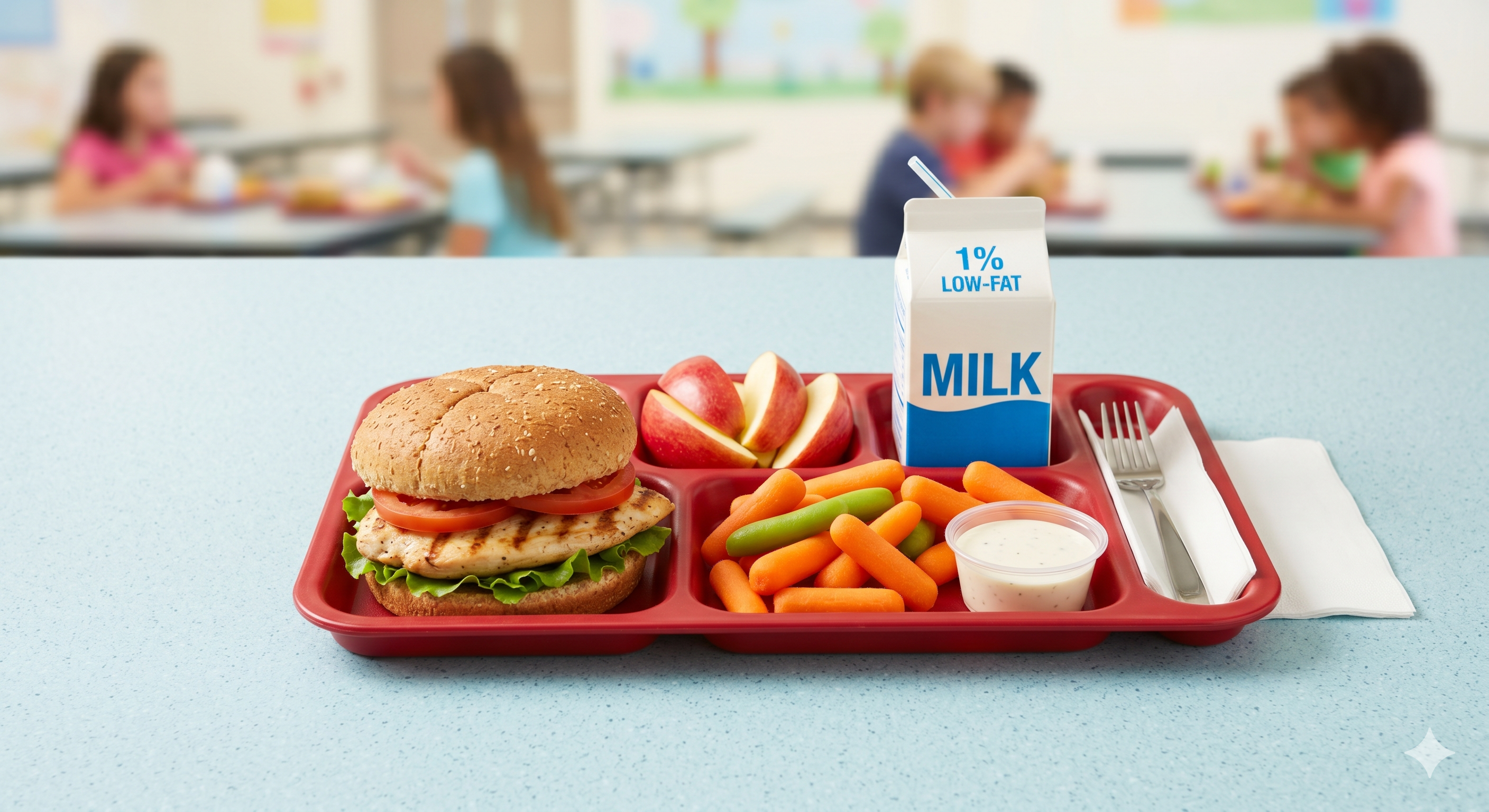

The National School Lunch Program (NSLP) serves nearly 30 million children every school day, making it one of the largest and most important nutrition safety nets in the country. For families struggling with grocery costs, free or reduced-price school meals can make a real difference — not just in the household budget, but in a child's ability to focus and learn.
Yet many eligible families never apply. Some assume they won't qualify. Others don't realize the program exists beyond elementary school. And some are unaware that qualifying for school meals can automatically unlock other benefits for their children and family.
How the Program Works
The NSLP is a federally funded program administered by the U.S. Department of Agriculture (USDA) through state education agencies. Participating schools receive federal subsidies for each meal they serve, which allows them to offer free or reduced-price lunches to students from households that meet income guidelines. Schools that participate must serve lunches that meet federal nutrition standards, including minimum requirements for fruits, vegetables, grains, protein, and milk.
The program also includes the School Breakfast Program (SBP), which operates under similar rules. Many schools that offer free or reduced lunch also offer free or reduced breakfast. Some schools also participate in afterschool snack and supper programs.
Income Eligibility Guidelines
Eligibility is based on household size and gross income. For the current school year, a family of four with a gross annual income at or below $40,626 qualifies for free meals, and a family of four earning up to $57,832 qualifies for reduced-price meals. The reduced-price lunch costs no more than 40 cents, and the reduced-price breakfast costs no more than 30 cents. Free meals have no cost at all.
These thresholds translate to 130 percent of the federal poverty level for free meals and 185 percent for reduced-price meals. The limits are higher for larger families and lower for smaller households.
Some children qualify automatically without a separate application. If your household receives SNAP, TANF (Temporary Assistance for Needy Families), or FDPIR (Food Distribution Program on Indian Reservations), your children are categorically eligible for free meals. Children who are homeless, migrant, runaways, or in foster care also automatically qualify.
How to Apply
At the beginning of each school year — and often at any point during the year — your child's school will distribute an application form. Many districts now accept online applications through their website. The form asks for basic household information: the names of all household members, income sources and amounts for each adult, and the last four digits of a Social Security number for the adult completing the form (or an indication that no SSN is available).
Submit the form to the school or district office. You'll receive a determination letter, usually within 10 school days, telling you whether your children qualify for free meals, reduced-price meals, or neither. If approved, the eligibility applies to all children in your household attending schools in that district.
You typically need to reapply each school year. However, if you received an eligibility carry-over letter at the start of the year (based on last year's approval), your children are covered for a grace period while you submit a new application.
Community Eligibility Provision
A growing number of schools and districts participate in the Community Eligibility Provision (CEP), which allows high-poverty schools to serve free breakfast and lunch to all students — regardless of individual family income. If your child's school is a CEP school, every student eats for free without needing to submit an application.
CEP schools are common in lower-income neighborhoods and districts. You can check with your school district to find out if your child's school participates.
Why It Matters Beyond the Cafeteria
Qualifying for free or reduced-price meals can unlock additional benefits. In many states and districts, students approved for free or reduced lunch are automatically eligible for reduced fees on standardized college entrance exams (SAT and ACT fee waivers), college application fee waivers, reduced-cost internet service through programs like the Affordable Connectivity Program's successors, and free or reduced fees for school activities and field trips.
School meal eligibility data also affects federal funding that flows to schools. When families don't apply, their school may lose out on resources that benefit all students — including Title I funding for academic support programs.
Common Concerns
Many parents worry about stigma — that their child will be singled out in the lunch line. Most schools today use systems that make it impossible for other students to tell who's paying full price and who's receiving free or reduced meals. Cafeteria point-of-sale systems process all students the same way.
Participation in the school meal program does not affect immigration status. The USDA has clarified that school meals are not considered a public benefit for immigration purposes, and applying does not require disclosing immigration status of any household member.
If your family's income changes during the school year — due to a job loss, a reduction in hours, or any other reason — you can submit a new application at any time. You don't have to wait until the next school year.
Sources
U.S. Department of Agriculture, Food and Nutrition Service. "National School Lunch Program." fns.usda.gov
USDA Food and Nutrition Service. "Child Nutrition Programs: Income Eligibility Guidelines." fns.usda.gov
/sites-cdn/openfinancial.co/images/2026/05/04/Gemini_Generated_Image_fhea9gfhea9gfhea.png?width=256&height=256&fit=cover)
/sites-cdn/openfinancial.co/images/2026/05/04/Gemini_Generated_Image_21fcul21fcul21fc.png?width=256&height=256&fit=cover)
/sites-cdn/openfinancial.co/images/2026/05/04/Gemini_Generated_Image_q1hbg5q1hbg5q1hb.png?width=256&height=256&fit=cover)
/sites-cdn/openfinancial.co/images/2026/05/04/Gemini_Generated_Image_z00edhz00edhz00e.png?width=256&height=256&fit=cover)
/sites-cdn/openfinancial.co/images/2026/05/04/Gemini_Generated_Image_fhea9gfhea9gfhea.png?width=448&height=448&fit=cover)
/sites-cdn/openfinancial.co/images/2026/05/04/Gemini_Generated_Image_21fcul21fcul21fc.png?width=448&height=448&fit=cover)
/sites-cdn/openfinancial.co/images/2026/05/04/Gemini_Generated_Image_q1hbg5q1hbg5q1hb.png?width=448&height=448&fit=cover)
/sites-cdn/openfinancial.co/images/2026/05/04/Gemini_Generated_Image_z00edhz00edhz00e.png?width=448&height=448&fit=cover)
/sites-cdn/openfinancial.co/images/2026/04/30/apply_for_snap_benefits.png?width=448&height=448&fit=cover)
/sites-cdn/openfinancial.co/images/2026/05/02/Gemini_Generated_Image_w9gc9w9gc9w9gc9w.png?width=448&height=448&fit=cover)