


There is currently more than $80 billion in unclaimed property held by federal and state governments across the United States. California alone holds approximately $15 billion. Texas has over $10.5 billion. Ohio sits on nearly $4.8 billion. And roughly one in seven Americans has money waiting to be claimed — many without knowing it.
Unclaimed money isn't a scam or a gimmick. It's a straightforward fact of how the financial system works: when banks, insurance companies, employers, utilities, and other entities can't locate the rightful owner of funds after a set period of inactivity — typically three to five years — state law requires them to turn that money over to the government. The government holds it indefinitely until someone comes forward to claim it.
This guide explains what unclaimed money is, where it comes from, and exactly how to search for yours — for free.
What Counts as Unclaimed Property
Unclaimed property is broader than most people realize. It includes dormant bank accounts (checking, savings, and CDs), uncashed paychecks or payroll checks, forgotten security deposits from utilities or landlords, life insurance proceeds that were never claimed by beneficiaries, uncashed dividend or interest checks, abandoned safe deposit box contents, state tax refunds and federal tax refunds that were returned as undeliverable, unused gift cards and store credits (in states that classify them as property), court settlements or class action payouts that were never collected, and pension or retirement benefits from former employers.
In most cases, the unclaimed property is money — not physical goods. But safe deposit box contents can include jewelry, coins, and other valuables, which some states eventually auction off if left unclaimed for extended periods.
Why Does Money Go Unclaimed?
The most common reasons are simple and ordinary. People move and forget to update their address with a bank or former employer. A relative passes away and the family doesn't know about an old insurance policy or bank account. A company sends a refund check to an outdated address and it bounces back. Someone changes their name after marriage and old accounts fall through the cracks.
Because these situations are so mundane, most people never think to look — which is exactly why the unclaimed property system exists. The money doesn't disappear. States are required to hold it and make it searchable so rightful owners (or their heirs) can reclaim it at any time.
How to Search: Your Step-by-Step Process
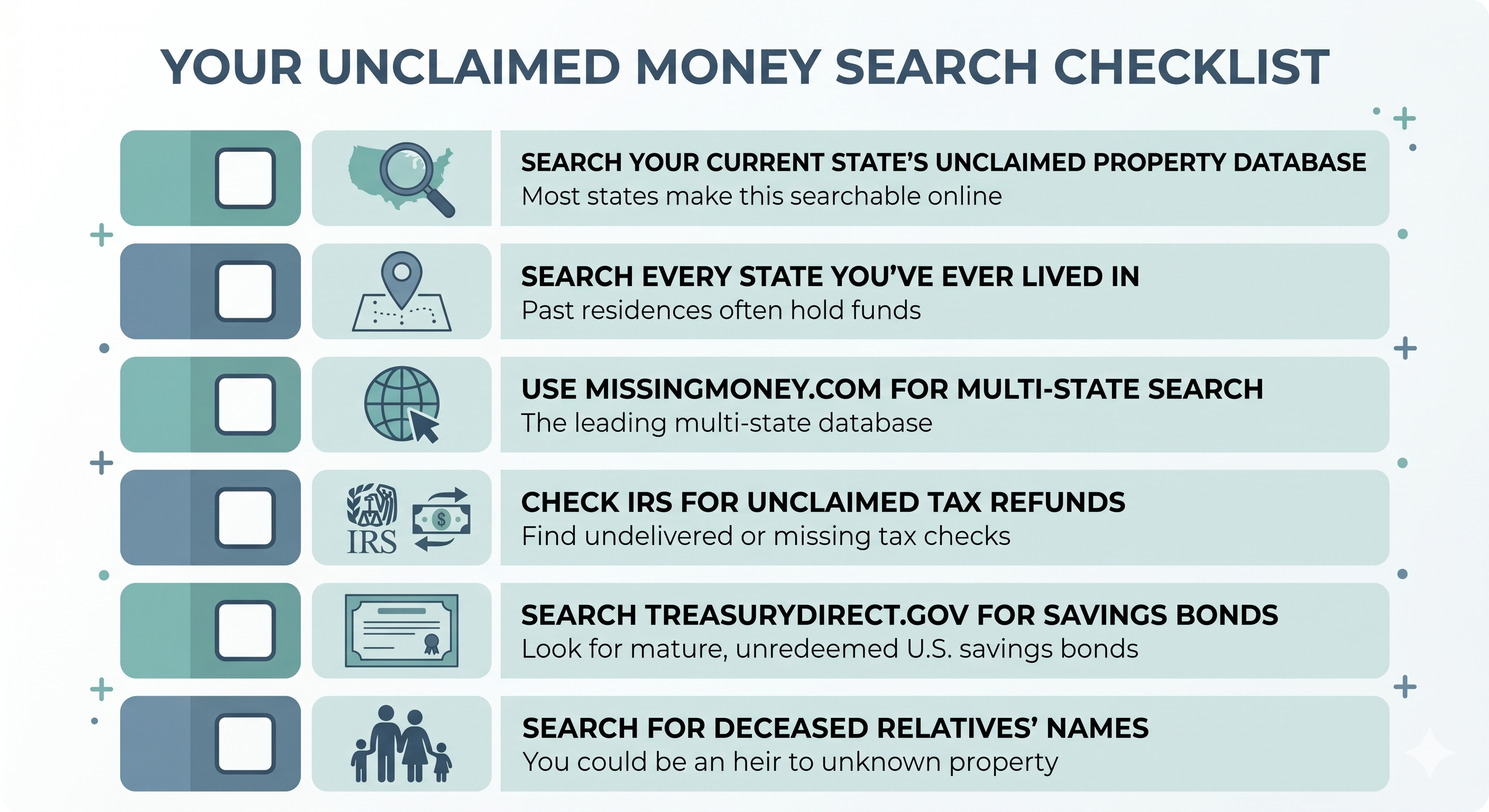
Start with your current state. Visit your state's unclaimed property office website. Every state has one, usually housed within the state treasurer's or comptroller's office. Search using your full legal name. Try variations — maiden names, former names, names with and without middle initials. Even small differences in how your name was entered by a company can affect whether a match appears.
Search every state you've ever lived in. Unclaimed property is turned over to the state where the account holder last had a known address. If you've lived in multiple states, you need to search each one individually. Companies also sometimes send unclaimed funds to the state where they're incorporated rather than where the account holder lives, so don't skip states just because you only lived there briefly.
Use the national search tool. MissingMoney.com is a free search tool managed by the National Association of Unclaimed Property Administrators (NAUPA). It lets you search most — but not all — state databases from a single site. It's a good starting point, but not every state participates fully, so following up with individual state searches is still important.
Check federal sources. For unclaimed tax refunds, check with the IRS. For unclaimed savings bonds, use TreasuryDirect.gov. For unclaimed pension benefits, the Pension Benefit Guaranty Corporation maintains a searchable database. For unclaimed FHA mortgage insurance refunds, check the HUD/FHA database. For VA benefits, contact the Department of Veterans Affairs.
Search for deceased relatives. You can and should search for unclaimed property in the names of deceased family members. Heirs are legally entitled to claim these funds. You'll need to provide documentation — typically a death certificate, proof of your relationship (birth certificate, marriage certificate), and in some cases a copy of the will or letters of administration.
How to File a Claim
When you find a match, the state's website will guide you through the claims process. This typically involves verifying your identity and proving you're the rightful owner (or heir) of the property. You may need to provide a government-issued photo ID, proof of address (current and former), Social Security number, documentation showing name changes if applicable, and for inherited property, a death certificate and proof of your relationship to the deceased.
Processing times vary by state — some resolve claims within weeks, while others may take several months, especially for larger amounts or cases requiring additional verification. The process is free. You should never have to pay a fee to search for or claim your own unclaimed property from a state government.
Watch Out for Third-Party Finders
You may receive letters from private companies offering to locate unclaimed property for you — for a fee, typically a percentage of the amount recovered. While these services are legal in most states, they're rarely necessary. Everything they do, you can do yourself for free through the official government databases. Some states cap the fees these companies can charge, and many require a waiting period before they can contact potential claimants.
If you do choose to use a finder service, verify they're licensed in your state and understand the fee structure before signing anything.
Make It a Habit
Unclaimed property databases are updated regularly as new funds are reported. A search that comes up empty today might show results next year. Make it a point to search your name — and the names of family members — at least once a year. It takes five minutes and could put real money back in your pocket.
Some states are becoming more proactive about returning funds. Illinois, for example, runs an automated program that cross-references unclaimed property records with state tax and address databases, then simply mails eligible residents a check — no search required. Other states are moving in this direction, but most still require you to take the initiative.
Sources
USAGov. "How to Find Unclaimed Money from the Government." usa.gov/unclaimed-money
National Association of Unclaimed Property Administrators (NAUPA). unclaimed.org
The Hill. "States Hold Billions in Unclaimed Funds: Are You Owed Any?" December 2025. thehill.com
/sites-cdn/openfinancial.co/images/2026/05/04/Gemini_Generated_Image_8ba6xq8ba6xq8ba6.png?width=256&height=256&fit=cover)
/sites-cdn/openfinancial.co/images/2026/05/04/Gemini_Generated_Image_thfzx2thfzx2thfz.png?width=256&height=256&fit=cover)
/sites-cdn/openfinancial.co/images/2026/05/04/Gemini_Generated_Image_po7j3dpo7j3dpo7j.png?width=256&height=256&fit=cover)
/sites-cdn/openfinancial.co/images/2026/05/04/Gemini_Generated_Image_1afvoj1afvoj1afv.png?width=256&height=256&fit=cover)
/sites-cdn/openfinancial.co/images/2026/05/04/Gemini_Generated_Image_8ba6xq8ba6xq8ba6.png?width=448&height=448&fit=cover)
/sites-cdn/openfinancial.co/images/2026/05/04/Gemini_Generated_Image_thfzx2thfzx2thfz.png?width=448&height=448&fit=cover)
/sites-cdn/openfinancial.co/images/2026/05/04/Gemini_Generated_Image_po7j3dpo7j3dpo7j.png?width=448&height=448&fit=cover)
/sites-cdn/openfinancial.co/images/2026/05/04/Gemini_Generated_Image_1afvoj1afvoj1afv.png?width=448&height=448&fit=cover)
/sites-cdn/openfinancial.co/images/2026/05/02/Gemini_Generated_Image_o63c8bo63c8bo63c.png?width=448&height=448&fit=cover)
/sites-cdn/openfinancial.co/images/2026/05/04/Gemini_Generated_Image_mlu3ekmlu3ekmlu3.png?width=448&height=448&fit=cover)